

Perimenopause can make you feel totally out of control, like your hormones have hijacked the steering wheel while you’re sitting in the passenger seat praying for the ride to end quickly.
The good news? That is NOT the case.
The bad news? Because you are the one actually in control, only you can set the course straight again and that involves doing some foundational work.
The reality of modern life isn't just that we're living longer; we are living lives that are far more stressful and demanding than this stage of life was ever designed for. Often, we are caring for children who still need us, supporting aging parents who need us more, navigating demanding careers because we’ve finally made progress, and carrying the lion’s share of the household mental load and housework.
How is this fair? The short answer is: it’s not!
While I can’t single-handedly change your daily schedule, what I can do is support your hormones, stress resilience, insulin sensitivity, and inflammation so you can move forward with strength, clarity, and grace.
I look at perimenopausal health in terms of 4 main pillars. Think of it like a table: four solid legs create a stable table.
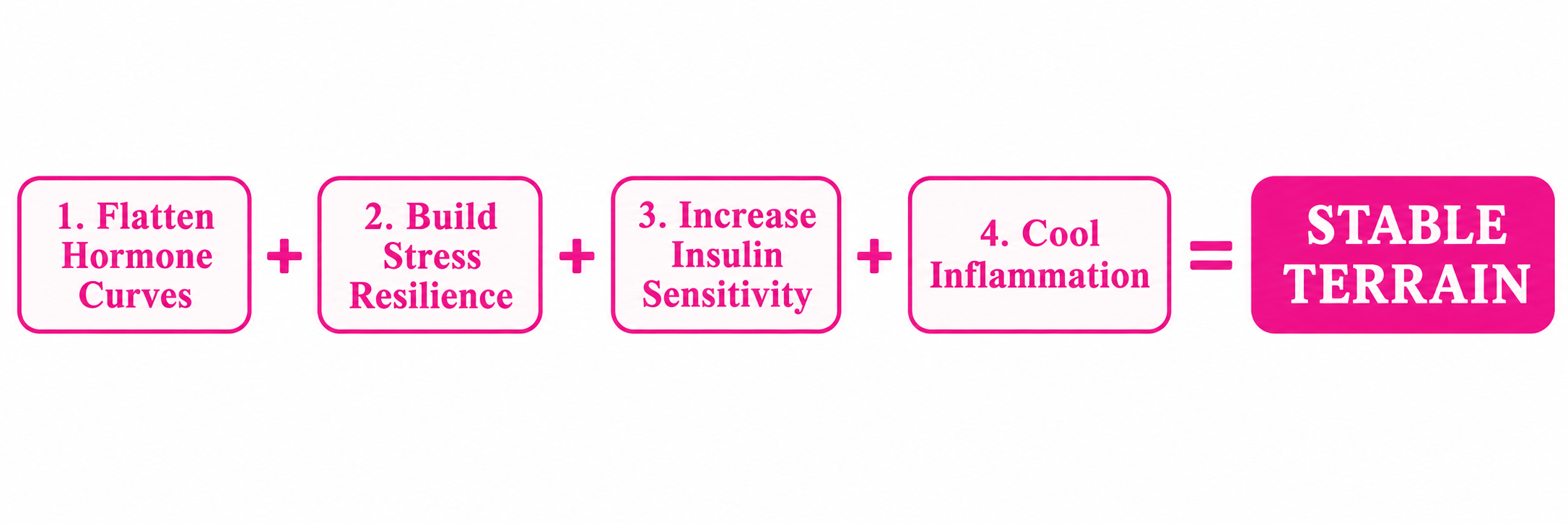
The 4 Pillars of Perimenopausal Health
1. Hormones: Flattening the Curve
You cannot stop nature from moving hormone levels south, but by supporting liver detoxification pathways and balancing the other three pillars, we can flatten the rollercoaster. We want a smooth, gradual downhill slope. Not a death-defying, unpredictable ride at Dreamworld!
2. Stress: Creating Resilience
Stress resilience is key. If your nervous system reacts to every minor inconvenience, perimenopause becomes a miserable cycle of anxiety, insomnia, heart palpitations, and emotional reactivity (Gordon et al., 2015). Stress drives progesterone down hard and fast. Since progesterone is your natural "calming" hormone, keeping things slow and steady gives your body a chance to buffer its loss.
3. Blood Sugar: Protecting Insulin Sensitivity
Estrogen naturally enhances insulin sensitivity. As estrogen dips, we lose that built-in metabolic buffer, meaning we have to work a little smarter to fill the gap (Craft et al., 2020). Is it impossible? Absolutely not! We just need to adjust our approach for our new, emerging bodies.
4. Inflammation: Interrupting the Loop
With declining estrogen, we lose tissue elasticity and feel more sore. Soreness adds to systemic inflammation, as do anxiety and chronic stress. Left unchecked, background inflammation contributes to elevated cholesterol, high blood pressure, and joint pain which then creates more stress and anxiety in a perpetual loop. Cooling inflammation interrupts that cycle.
Looking Beyond Just Hormones (A Note on MHT)
It’s easy to blame hormones alone and think, "If I just supplement them, I can keep holding the whole world together."
The reality is vastly different. While hormones matter, so do the other three pillars. Address all four, and the results are incredible. Address just the hormones while ignoring stress, insulin, and inflammation, and you can end up relying on endless bands of supplements and medications for years to come.
A Quick Note on Menopausal Hormone Therapy (MHT): Do you? Don't you? What do I think? I believe every woman is completely free to make her own informed decisions, and I will 100% support you regardless of your choice around MHT. Some women find it extraordinarily helpful, others less so, and many still experience ongoing metabolic issues while on it.
I get fantastic clinical results for women both with and without MHT. Why? Because it isn't all about sex hormones. Other foundational factors influence your terrain. I look at the whole picture: all of you, not just one piece of the puzzle.
The Most Comprehensive Start: Getting Food Right First
The most effective starting line for your perimenopause journey is getting your nutrition right first. When we align your food with your unique biochemistry, most of the battle is already won. Whatever is left over can be dealt with far more easily with much less intervention.
This is why I use Metabolic Balance® with such great success in my clinic:
Flatten the hormone curve? Tick.
Build stress resilience? Yep.
Increase insulin sensitivity? You bet.
Reduce systemic inflammation? Hell yes.
By using your 36+ blood pathology markers to create an individualized whole-food plan, Metabolic Balance® addresses all 4 pillars at once, providing a clean, stable foundation so you can thrive.
Click here to book a 15-Minute First Step Chat with me today Let's look at your whole picture, get your food right, and build your 4-pillar blueprint together. Go on, you good thing!
Further Reading & Peer-Reviewed References
Craft, S., et al. (2020). Insulin resistance and cognitive decline: Mechanisms and clinical implications. Lancet Neurology, 19(7), 612–624. https://pmc.ncbi.nlm.nih.gov/articles/PMC9661919/
Gordon, J. L., et al. (2015). Ovarian hormone fluctuation and physiological stress reactivity in perimenopausal women. Psychoneuroendocrinology, 62, 110–121.https://pmc.ncbi.nlm.nih.gov/articles/PMC4513660/
Simply Healing is a naturopathic clinic led by Sarah Dobbs in Kuranda, QLD (30 mins from Cairns), offering Metabolic Balance® and holistic care in-person and online Australia-wide.