
You’ve tidied up your diet, you’re doing the stress resilience work, and you’re getting to sleep early (and working hard to stay asleep). Yet you’re still waking up dragging your feet.

It’s frustrating, disheartening, and a pattern I see in my clinic every single week. You’ve targeted and plugged all the major "lifestyle energy leaks," so why are you still struggling through your afternoon?
To answer that, we have to zoom past your diet and look directly at your cellular batteries.
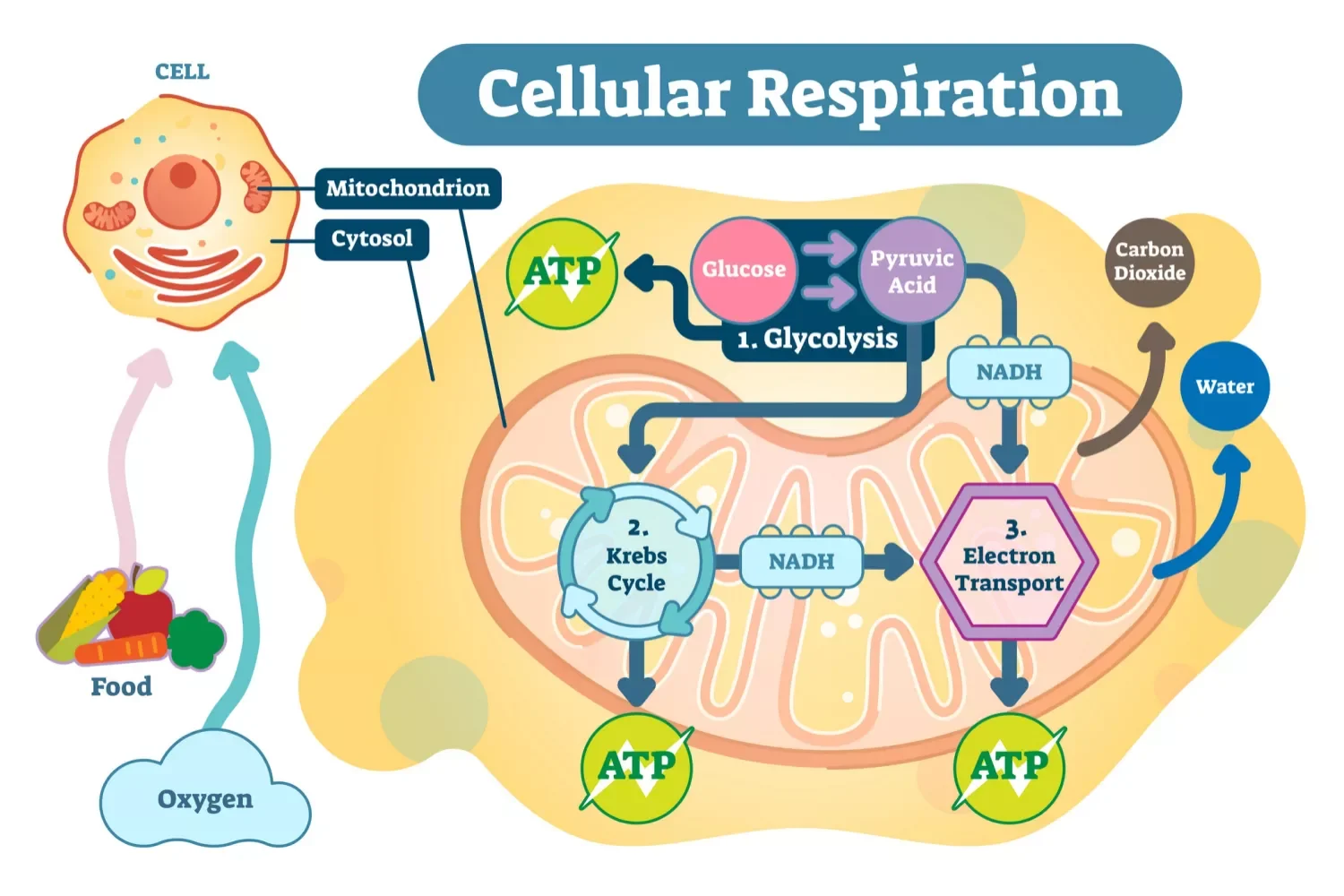
Mitochondrion: Your internal cellular energy generator… Source: Cellular respiration - Definition and Examples - Biology Online Dictionary
The Powerhouses Inside Your Cells
Deep inside your cells sit microscopic power stations called mitochondria. They take the raw products from the food you eat and the oxygen you breathe and convert them into adenosine triphosphate (ATP), the biological energy currency your brain and body use every second.
It’s an intricate, highly coordinated system. But if even one small gear in that pathway stalls, the entire energy line slows to a crawl (Picard, M., & Shirihai, O. S. (2022).)
If you're doing "everything right," why are your cellular power stations still struggling?
Why Your Cellular Batteries Are Running Flat
Popping a generic multivitamin or relying on high-dose supplements is often just a bandaid fix (and a supplement company’s dream come true!). To get true, lasting vitality, we have to ask why your cellular nutrient levels are struggling to bounce back:
1. Reduced Digestive Capacity
Digestive enzyme and stomach acid (HCl) production naturally drop as we age and plummet under chronic stress. You need strong stomach acid to cleave apart proteins and extract essential minerals like iron, zinc, and B-vitamins. But here’s the kicker: you need zinc to make stomach acid in the first place (Scarpellini, Emidio et al. (2022).). Once that cycle breaks, your cells stop receiving the raw materials they need.
2. Epigenetic & Genetic Variations
Nutrients ingested from food often need to be converted into active, usable forms in the body. Variations in specific genes (like MTHFR) mean your body might struggle to convert synthetic forms like folic acid into active methylfolate, leaving your biochemical pathways running short (Zarembska, Emilia et al. (2023).).
3. Stress-Induced Mitochondrial Strain
While your body works overtime to keep you functioning, prolonged psychological and physical stress inflicts direct structural strain on mitochondrial membranes (Picard, M., & Shirihai, O. S. (2022).). Your survival instinct tricks you into thinking you’re "coping fine," but behind the scenes, your cellular engine is running on fumes.
4. Recovery Takes Real Time
We live in a world of quick fixes, but nervous system and cellular recovery from burnout doesn't happen after two nights of good sleep and a few healthy meals. True recovery from prolonged stress can take 1 to 2 years of slow, persistent, daily self-care and the "boring" repetition of core health habits.
Unraveling the Mystery
If you're feeling stuck in a loop of fatigue despite your best efforts, take a step back. Where are the biochemical gaps you haven't considered? Is it digestive breakdown, cellular mineral depletion, or simply a lack of targeted support?
Unraveling that mystery, finding the hidden gaps, ordering targeted functional testing when necessary, and building a realistic, step-by-step recovery plan is exactly what I do.
Click here to book a 15-Minute First Step Chat with me today. Let’s look past the bandaid fixes and recharge your cellular health from the inside out. Go on, you good thing!
Further Reading & Peer-Reviewed Resources
Picard, M., & Shirihai, O. S. (2022). Mitochondrial signal transduction. Cell Metabolism, Volume 34, Issue 11, 1 November 2022, Pages 1620-1653
Simply Healing is a naturopathic and homeopathic clinic led by Sarah Dobbs, nestled in the rainforest of Kuranda. Just 30 minutes from Cairns. We specialize in Metabolic Balance and holistic health, supporting clients in person across Far North Queensland or online Australia-wide.